





Biosafety Levels
S3: Science Safety Security
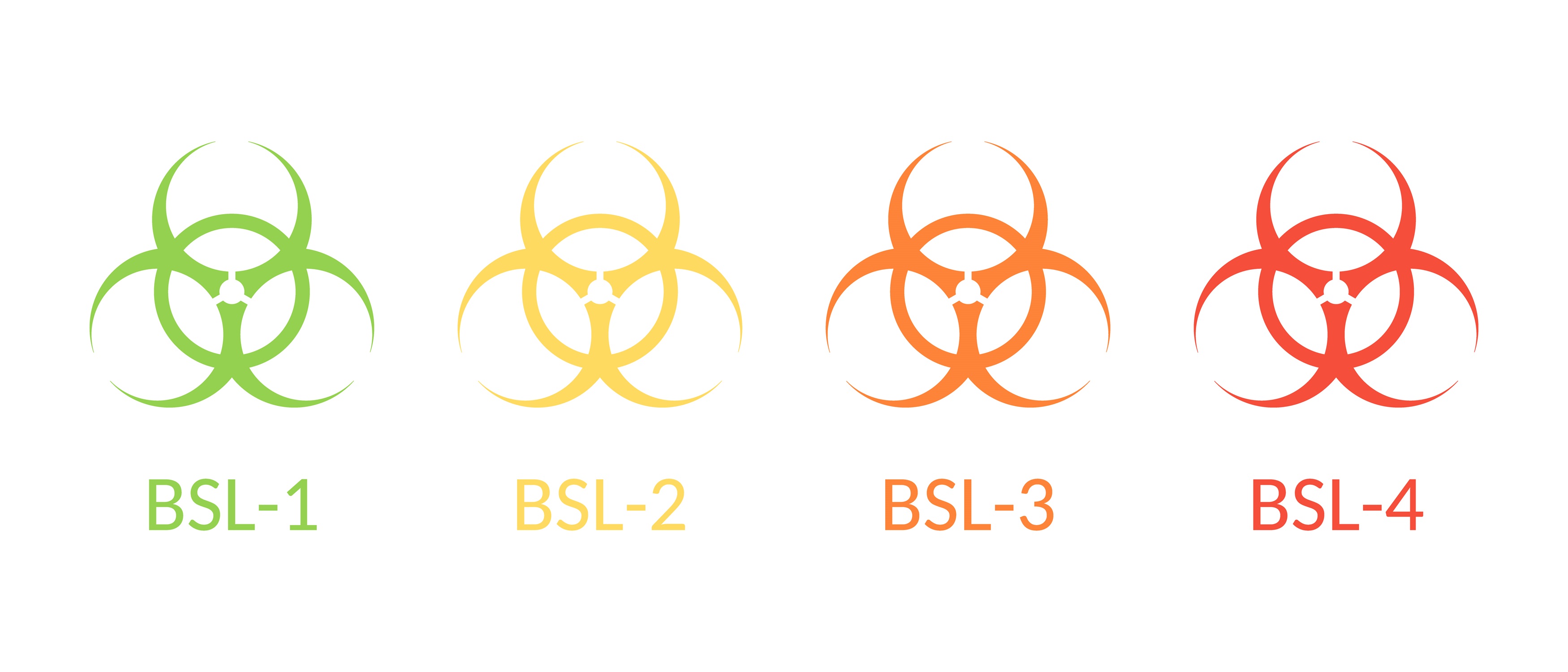
Biosafety levels (BSL) are used to identify the protective measures needed in a laboratory setting to protect workers, the environment, and the public. The levels are defined in Biosafety in Biomedical Laboratories (BMBL). Biosafety level designations in the BMBL outline specific practices and safety and facility requirements. There are many ways to combine equipment, practices, and laboratory design features to achieve appropriate biosafety and biocontainment. These are determined through biological risk assessments specifically conducted for each experimental protocol.
A risk assessment of the infectious agent or toxin and the procedures to be performed is used to determine the appropriate containment facility, equipment and work practices that will promote the safe conduct of the research project. Important differences exist between risk assessment criteria for public health and worker protection, and requirements for animal, plant, and agricultural containment.
A risk assessment is a process used to identify the hazardous characteristics of a known infectious agent or toxin or potentially infectious agent, toxin, or material, the activities that can result in exposure to that agent, the likelihood that such exposure will cause an infection, and the probable consequences of such an infection. The importance of risk assessment cannot be overemphasized. The information identified through a risk assessment is used to guide the selection of appropriate microbiological practices, safety equipment, and facility safeguards that, when used properly, can prevent exposures and dramatically reduce the incidence of laboratory-acquired infections. Risk assessment is a common first step in an overall risk-management process.
The risk assessment process is also discussed in Biosafety in Microbiological and Biomedical Laboratories.
At any given biosafety level, there will be strict requirements for laboratory design, personal protective equipment, and biosafety equipment to be used. Standard Microbiological Practices are required at all biosafety levels and are good practice for experiments below the BSL-1 threshold.
Activities and projects conducted in biological laboratories are categorized by biosafety level. The four biosafety levels are BSL-1, BSL-2, BSL-3, and BSL-4, with BSL-4 being the highest (maximum) level of containment. There are additional specific rules and designations for animal research (ABSL), agricultural research (BSL-Ag), and other types of research. These other types of labs require their own specific set of rules and regulations, because they are dealing with larger organisms, such as plants, animals, and insects. Learn more about Biosafety Level Requirements.
BSL-1 labs are used to study infectious agents or toxins not known to consistently cause disease in healthy adults. They follow basic safety procedures, called Standard Microbiological Practices and require no special equipment or design features. Standard engineering controls in BSL-1 laboratories include easily cleaned surfaces that are able to withstand the basic chemicals used in the laboratory.
BSL-2 laboratories are used to study moderate-risk infectious agents or toxins that pose a risk if accidentally inhaled, swallowed, or exposed to the skin. Design requirements for BSL-2 laboratories include hand washing sinks, eye washing stations in case of accidents, and doors that close automatically and lock. BSL-2 labs must also have access to equipment that can decontaminate laboratory waste, including an incinerator, an autoclave, and/or another method, depending on the biological risk assessment.
BSL-3 laboratories are used to study infectious agents or toxins that may be transmitted through the air and cause potentially lethal infection through inhalation exposure. Researchers perform all experiments in biosafety cabinets that use carefully controlled air flow or sealed enclosures to prevent infection. BSL-3 laboratories are designed to be easily decontaminated. These laboratories must use controlled, or "directional," air flow to ensure that air flows from non-laboratory areas (such as the hallway) into laboratory areas as an additional safety measure.
BSL-3 laboratories are used to study infectious agents or toxins that may be transmitted through the air and cause potentially lethal infection through inhalation exposure. Researchers perform all experiments in biosafety cabinets that use carefully controlled air flow or sealed enclosures to prevent infection. BSL-3 laboratories are designed to be easily decontaminated. These laboratories must use controlled, or "directional," air flow to ensure that air flows from non-laboratory areas (such as the hallway) into laboratory areas as an additional safety measure.
BSL-4 laboratories are used to study infectious agents or toxins that pose a high risk of aerosol-transmitted laboratory infections and life-threatening disease for which no vaccine or therapy is available. The laboratories incorporate all BSL 3 features and occupy safe, isolated zones within a larger building or may be housed in a separate, dedicated building. Access to BSL-4 laboratories is carefully controlled and requires significant training.
There are two types of BSL-4 laboratories:
Cabinet laboratory – all work with infectious agents or toxins is done in a Class III Biosafety Cabinet with very carefully designed procedures to contain any potential contamination. In addition, the laboratory space is designed to also prevent contamination of other spaces.
Suit laboratory – Laboratory personnel are required to wear full-body, air-supplied suits, which are the most sophisticated type of personal protective equipment. All personnel shower before exiting the laboratory and go through a series of procedures designed to fully decontaminate them before leaving.
The engineering controls required are different for BSL-4 cabinet and suit laboratories. For either type, they are extensive and supplemented by carefully designed procedures and practices.